

Lightspeed Saber Academy
8314 On the Mall
Buena Park, CA 90620
Sat, 8/29, @4 PM
Registration closes Thu, 8/27
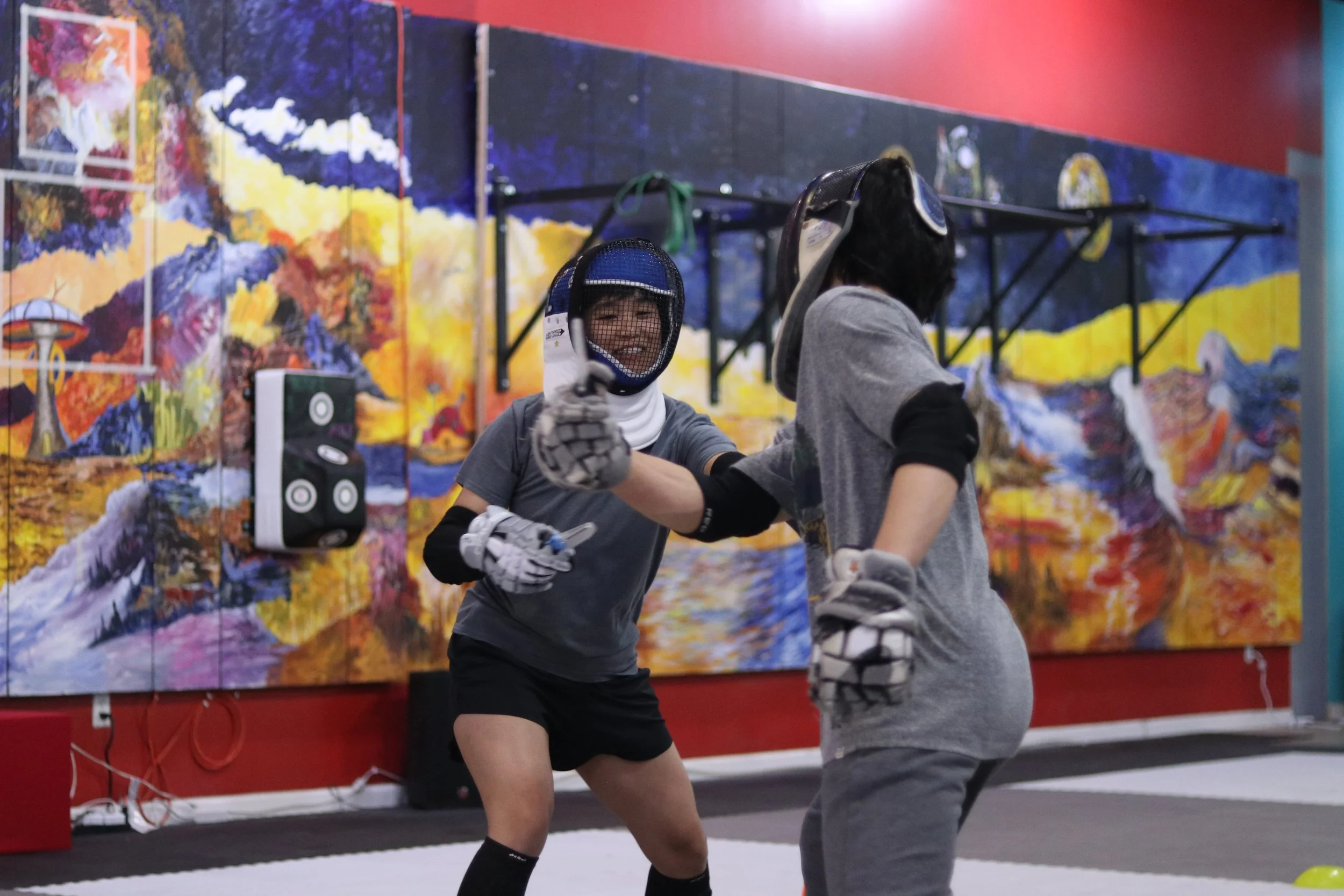

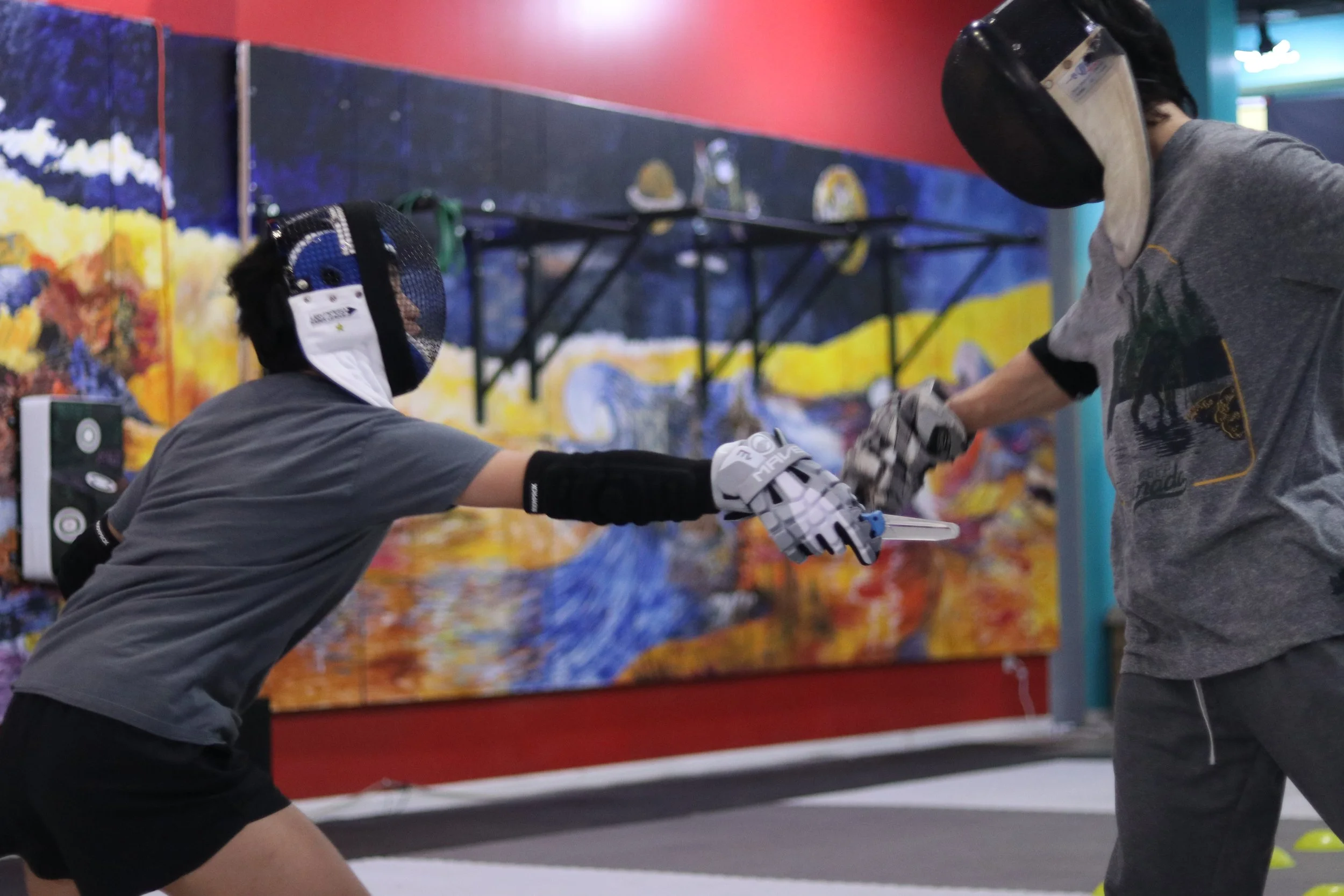
We’re still developing this ruleset. Try it and let us know what you think!
LS Knife, or knife fencing, is a contest between two competitors simulating knife “combat”. Fencers fight until the first touch is made, after which the fight is paused and the referees decide who earns points, if any. The fight then resumes. The first fencer to reach match point wins, or, the fencer with the most points at the end of time wins.
A limited amount of hand-to-hand manipulation is allowed. Only “clean hits” score.
UPDATES
Updates may or may not be permanent and/or experimental.
9/10/2026
Head and torso are now worth 2 points instead of 1. Doubles are still zero points, regardless of target areas struck.
Triple-Double rule added.
Format points adjusted from 3/6/9 to 5/10/15. Times unchanged.
Clarifying rules for afterstrike and out-of-bounds added.
PARTICIPANTS
Open to anyone aged 14 and up and any gender or weight class.
EQUIPMENT
Participants must wear:
Head protection & neck protection (fencing mask or equivalent)
Padded gloves (hockey, lacrosse, or equivalent)
Weapon must be an electronic Mimic T-16 (by AkuStrike) or equivalent (will be provided by venue)
SCORING
Scoring is achieved by either stabbing or slicing the opponent hard enough such that the electronic knife sounds off. Only attacks to legal target areas are valid (see below). Hits to the head and torso are worth 2 points. All other legal targets are worth 1. Double hits, where both fencers are struck simultaneously or in near succession, are worth zero, regardless of targets.
Going out of bounds is 2 points to the opponent. Going out of bounds while scoring or after scoring neutralizes the HIT (NOT the point). The play area is a 10-12’ box.
AFTERSTRIKE
Upon the first hit of an encounter landing, the struck fencer may make one attempt to double with their opponent (the landed fencer), thus negating their point. For the double to be valid, the hit must land within one attack, one footstep, two seconds, or 180° of body rotation, whichever comes first. The landed fencer is free to defend themself, dodge, or move out of range.
TARGET AREA
The entire body is valid for attack except the groin and the feet. The opponent’s knife is technically a valid target but it is worth zero. The head and torso have special rules. See below.
ATTACKS
LEGAL:
Slicing to any valid target area.
Stabbing to any valid target area EXCEPT the head and torso.
🚩ILLEGAL:
🚩Stabs to the head and torso.
🚩Attacks where the knife sounds for more than one pulse or is otherwise judged as reckless or unsafe.
🚩Throwing the weapon.
MANIPULATION
LEGAL:
Pushing, pulling, and deflecting of the opponent’s arms, hands, and weapon.
🚩ILLEGAL:
🚩Manipulation of the opponent’s torso, head, shoulder, or legs.
🚩GRABBING the opponent in any way.
🚩Punching, kicking, tripping, shoving, headbutting, etc.
OTHER RULES
OUT-OF-BOUNDS. Going out of bounds is two points to the opponent.
OOB INERTIA. Any attacks landed while out of bounds or going out of bounds— even after the hit has landed— are treated as inert (as if they never landed).
Example: The fencer who did not go out of bounds may earn points, even if they did not hit first, and even if it was a double.
AFTERSTRIKE. An afterstrike is defined as an attack that begins after the primary hit is made. Therefore:
Example: Attacks, steps, and turns concurrent to the primary strike do not count toward the one afterstrike/step/turn limit, and the struck fencer still has an opportunity to go for a double.
MAX AWARD. The most points that can be awarded to a fencer from a single encounter is two. Therefore:
Example: If Jerry strikes Ann on the head (worth 2 points) while Ann is going out of bounds (worth 2 points), Jerry will be awarded 2 points, not 4.
TRIPLE-DOUBLE RULE. If three doubles occur in a row, priority will be randomly assigned to one fencer. The priority fencer will receive 2 points on the next double. Should priority be required again within the same match, it will go to the other fencer. Priority lasts for exactly one encounter.
SMART RANDOM ASSIGNMENT. To ensure fairplay while preventing gamesmanship, priority is assigned differently depending on the instance. For all odd instances (1st, 3rd, 5th, etc) , it is assigned randomly. For all even instances (2nd, 4th, 6th, etc), it is assigned to the fencer who was not prioritized in the last instance. See example below:
1st instance: randomly assigned
2nd instance: opposite fencer
3rd instance: randomly assigned
4th instance: opposite fencer
And so on.
COMPETITION FORMAT
(tournaments may vary)
Combination competition format consisting of round robin pools, followed by elimination brackets.
Pools:
First to 5 points
1 minute fight time
Brackets:
First to 10 points
2 minutes fight time
Finals:
First to 15 points
3 minutes fight time